How often did team members explain things in a way you could understand?
"How often did team members explain things in a way you could understand?”
It isn't only whether you 𝘦𝘹𝘱𝘭𝘢𝘪𝘯𝘦𝘥 information clearly.
It's whether a patient 𝘩𝘦𝘢𝘳𝘥 you clearly.
When you are providing care or service via the telephone, you don't have the advantage of spotting a visual clue that the person you are speaking with hasn't heard you correctly — or is confused by your message.
In person, we notice. The blank stare. A furrowed brow. The slight hesitation. And when we see those nonverbal cues, typically, we pause — giving the patient the opening to say "I'm sorry, what?" In phone conversations, those signals disappear and a misunderstanding remains undetected.
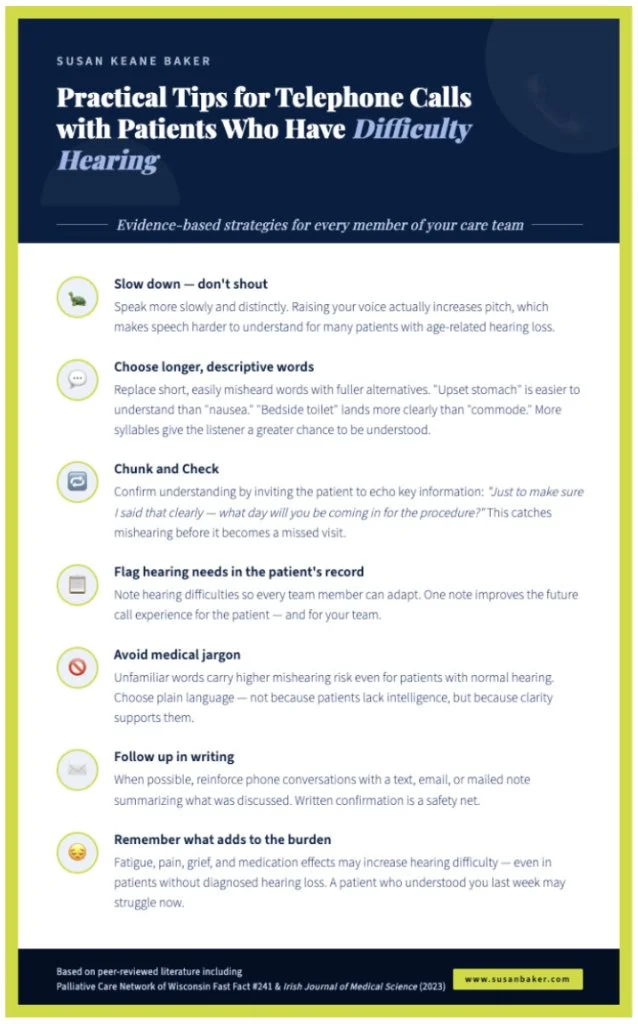
Speaking louder when someone can’t hear us may feel instinctive, but it can make a situation worse. For some patients with hearing loss, raising your voice increases pitch, and reduces clarity rather than improving it.
The solution is rarely volume. It’s awareness of how to care differently.
Short, one-syllable words — "pill," "fall," "ride," "pain" — are especially vulnerable to being misheard over the phone. Longer, more descriptive alternatives give patients more to hold onto. "Upset stomach" lands more reliably than "nausea." "Bedside toilet" is clearer than "commode." The "Chunk and Check” technique — pausing to invite a patient to repeat back what they've heard — catches a misunderstanding before it becomes a missed visit, a medication error, or a frightened family member.
Speaking differently is a skill — and skills can be taught, practiced, and improved.